
Not every tree with a structural concern needs to come down. Cabling and bracing provides supplemental support for trees with co-dominant stems, heavy limbs, or storm damage — giving at-risk trees a second chance while reducing failure risk.
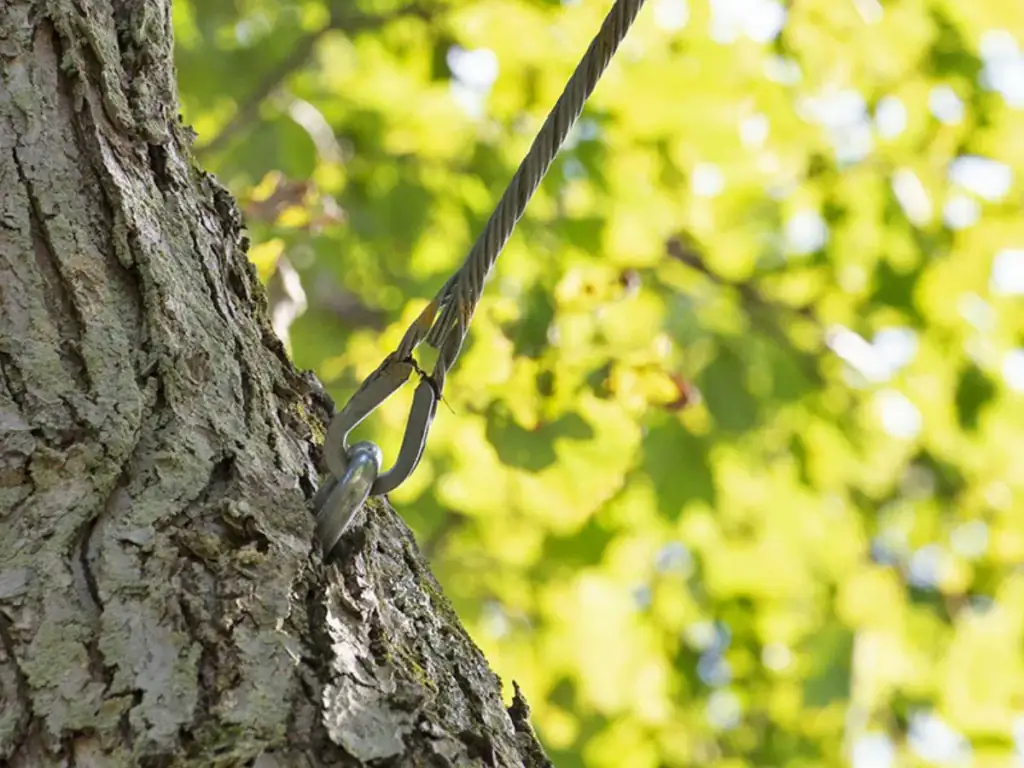
Many trees that look like removal candidates can be structurally stabilized and preserved with the right cabling or bracing system. Our arborists assess each situation to determine whether cabling is a viable alternative — and if it is, the appropriate system for that specific tree.
Cabling installs flexible steel cables between major limbs to limit movement and reduce failure risk. Bracing uses threaded steel rods to repair split crotches and hold co-dominant stems together. Both methods follow ANSI A300 standards — the recognized benchmark for professional tree care.
Trees with two or more equally-sized main stems are prone to splitting at the crotch — especially under ice and wind load. Cabling limits movement between the stems and significantly reduces the risk of catastrophic failure.
Long, heavy horizontal limbs can fail under their own weight over time, particularly on older trees. Supplemental cabling transfers some of that load back to the trunk and reduces the risk of limb failure.
Trees that have suffered partial failure in a storm can sometimes be stabilized and preserved rather than removed. Our arborists assess the tree's structural viability and recommend the right approach.
Cabling is a supplement to proper tree care — not a substitute for it. If a tree has significant decay, disease, or structural compromise that cabling can't address, we'll tell you honestly. We never cable a tree that should come down.
01
An arborist comes to your property and evaluates the tree's structure, species, age, and overall health. We identify specific defects — co-dominant stems, cracks, decay, overextended limbs — and assess the actual failure risk.
02
We give you a straight answer: cabling is appropriate and here's why, or this tree should come down and here's why. We don't cable trees just to avoid removal conversations — if removal is right, we'll say so.
03
If cabling or bracing is the right call, we install the system using hardware and techniques that meet ANSI A300 standards. The system is designed to reduce failure risk while allowing natural tree movement.
04
Cabling systems require periodic inspection — typically every 1–3 years — to ensure hardware is functioning correctly as the tree grows. We'll advise on the appropriate inspection interval for your specific situation.
Cabling reduces the risk of tree failure — it does not eliminate it. No structural support system can guarantee a tree won't fail. Our arborists are candid about what cabling can and can't accomplish for a given tree.
Large, mature trees represent decades of growth and significant property value. When a mature tree has a fixable structural issue, cabling is often a far better outcome than removal — for the property and for the environment.
A tree with a co-dominant stem overhanging your roof or garage is a real risk. Cabling that stem doesn't just protect the tree — it protects the structure below it from a potential failure event.
Storm damage sometimes leaves trees with partially failed stems or limbs that are still attached and viable. A timely assessment can determine whether stabilization is possible — don't wait, as the window to act narrows quickly.
Common indicators include: two or more equally-sized main stems (co-dominant stems) with a tight V-shaped crotch, long heavy horizontal limbs with no lateral support, visible cracks or splitting at branch unions, or a tree that has suffered partial storm damage but is otherwise healthy. When in doubt, call us — we’ll come out and give you an honest assessment.
Sometimes yes. Many trees that appear to be removal candidates have structural issues that can be addressed with cabling or bracing. But not every tree is a candidate — decay, disease, and certain structural defects can make cabling ineffective. Our arborists assess each situation honestly.
Hardware typically has a useful life of 10–15 years or more, but the system needs periodic inspection — usually every 1–3 years — to ensure it’s functioning correctly as the tree grows. We’ll advise on the right inspection interval for your tree.
No. Cabling reduces the risk of failure — it doesn’t eliminate it. No system can guarantee that a tree won’t fail under extreme conditions. Our arborists are transparent about what cabling can and can’t accomplish.
Cabling uses flexible steel cables installed in the upper crown to limit movement between major stems or limbs. Bracing uses threaded steel rods installed through split crotches or weak unions to physically hold them together. Some situations call for one, some for both.
Cost depends on the tree’s size, the number of cables or bracing rods needed, and accessibility. We provide on-site estimates — call 262-710-2796 or fill out our quote form.
Waukesha County
Milwaukee County
Racine County