
If you have an ash tree in Southeast Wisconsin, you have a decision to make. And the longer you put it off, the fewer options you have.
Emerald ash borer (EAB) is a small, metallic-green beetle from Asia. It was first found in Wisconsin in 2008, and it has since spread through Waukesha, Milwaukee and Racine counties. It has killed most of the untreated ash trees in the area, and it’s still working on the rest.
Here’s how to tell if your ash is infested, when it can still be saved, and when it needs to come down.
First: is it even an ash?
Ash trees have leaves made up of 5 to 11 leaflets arranged in pairs along a stem, branches that grow directly opposite each other, and mature bark with a tight diamond-shaped pattern. Not sure? Our arborists can tell you in about two seconds.
Signs of emerald ash borer
- Thinning from the top down. The canopy gets sparse, starting at the top of the tree.
- Woodpecker damage. Woodpeckers love EAB larvae. Patches of bark stripped off, leaving light-colored spots (people call it “blonding”), are a dead giveaway.
- D-shaped exit holes. Tiny holes, about 1/8 inch, shaped like the letter D, where adult beetles chewed their way out.
- S-shaped tunnels under the bark. Where bark has split or fallen off, you’ll see winding galleries the larvae carved.
- Suckers. Bunches of new shoots sprouting from the trunk or base as the tree tries to survive.
Treat it: when it’s worth saving
An ash that’s still mostly healthy can often be protected. Treatment is usually a trunk injection repeated every couple of years for as long as you want to keep the tree. It works best on trees that have lost less than about a third of their canopy.
Treatment makes the most sense when:
- The tree is healthy, or only lightly affected
- It’s a big, valuable shade tree in a spot where you really want a tree
- You’re willing to keep up with treatments long term
Remove it: when it’s past the point of no return
Once an ash has lost a big chunk of its canopy, treatment usually isn’t worth the money. The tree is going to die, and the question becomes how fast you deal with it.
Here’s what most people don’t know: dead ash is one of the most dangerous trees to leave standing. Ash wood dries out and gets brittle fast after the tree dies. Limbs drop without warning. Whole trees snap in storms. And a tree that’s too brittle to climb safely takes more equipment and more time to remove, which means it costs more.
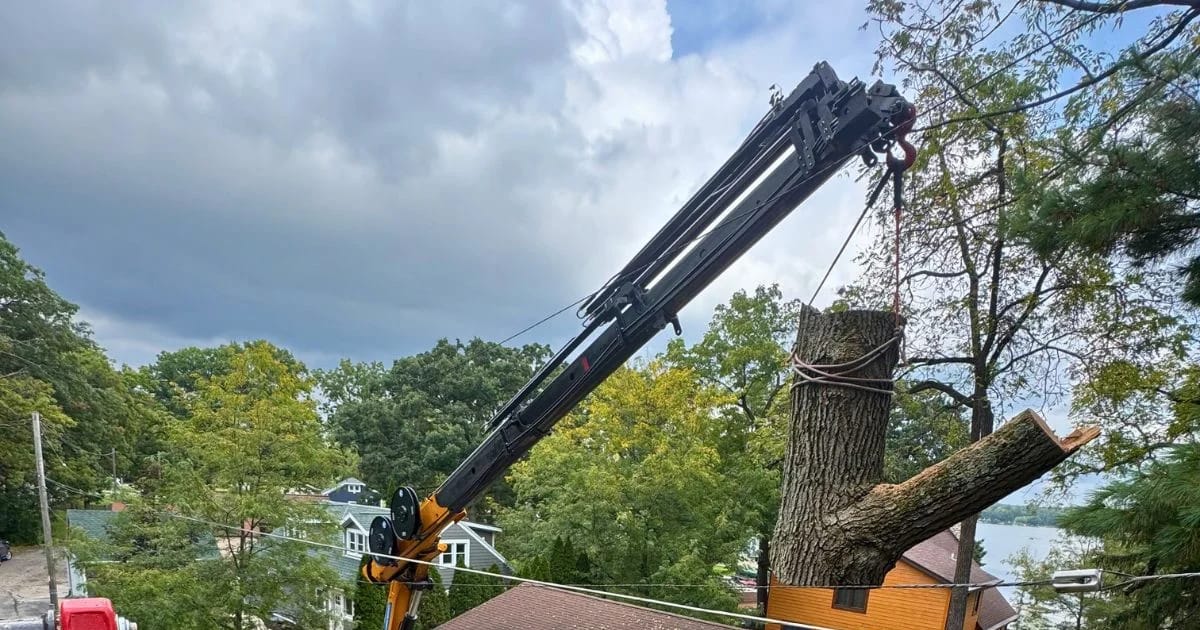
We see it constantly. A homeowner waits a couple of years on a dead ash, and a job that could have been simple turns into a careful, piece-by-piece removal with the grapple saw truck or the spider lift because nobody can safely climb it anymore.
Dead ash never gets cheaper to remove. It only gets more dangerous.
What about the wood?
Ash from infested trees shouldn’t be hauled long distances as firewood, because moving it can carry the beetles to new areas. Burn it locally or let us haul and chip it.
Get a straight answer
Our arborists will tell you honestly whether your ash is worth saving or whether it’s time for it to come down. If it can be saved, we’ll say so. If it’s a hazard, we’ll say that too, and we’ll take it down safely, protect your yard, and leave the place clean.
We serve Waukesha, Brookfield, New Berlin, Muskego, Pewaukee, Oconomowoc and 20+ more communities across Southeast Wisconsin, with 740+ five-star reviews behind us.
Call 262-402-3990 or request your free estimate online. Tree Service Done Right. Zero Excuses.